I write speculative fiction, cultural criticism, humor, and journalism, with a particular interest in retrofuturism, video games, fandom, and forgotten corners of pop culture history. My work has been published by Wired, Rolling Stone, Slate, McSweeney’s, Adventitious, The Daily Tomorrow, Alta Journal, Flash Fiction Online, and Nature: Futures. I also publish the newsletter Pop Cultural Precursors.
Found: Museum exhibit about life in 2008
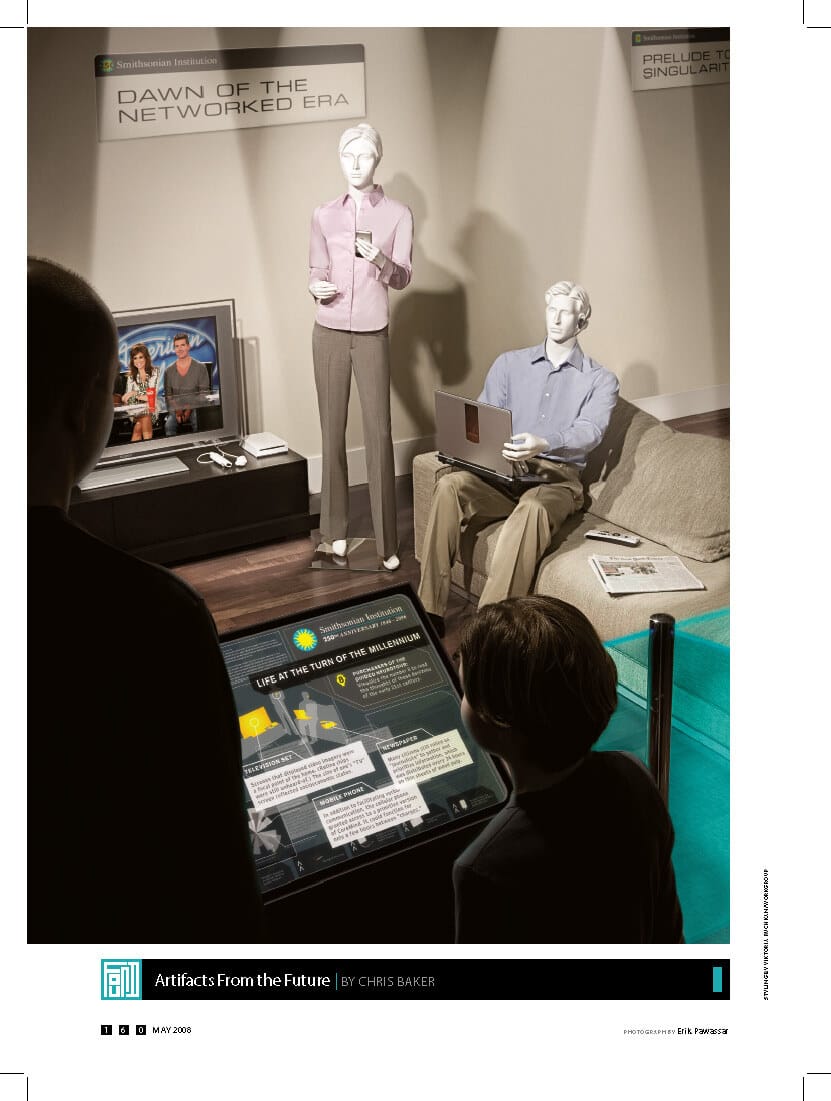
Found: Museum exhibit about life in 2008In 2096, The Smithsonian shows what life was like way back at the dawn of the networked era One of my favorite projects when I was an editor at Wired magazine was the monthly back-page item Found: Artifacts From the Future. Each installment was a full-page image of some found object from a speculative near future. All explanation of what the object was and how it worked had to be diegetic—i.e., the page had to explain itself entirely through context and in situ text, with no annotation or caption. This was a great challenge for me as a writer/editor and for all of the designers, illustrators, and photographers I had the pleasure of working with. These pages never made much of an impact online because the fun was always in the fine print—which rarely came through at web resolution. I’m republishing them here to drill down on those cool details.
This piece from May of 2008 is a perfect example of how these pages often didn’t work when they were shrunk down to web resolution. I wanted to do a Smithsonian exhibit from the year 2096, based on my own memory of some crude mannequins in prehistoric garb that I saw in a natural history museum when I was a kid. The joke is that from museum visitors’ post-Singularity vantage point, the tech and culture of 2008 would seem as primitive and strange to them as neolithic tools and clothing would have seemed to my younger self. The artists, designers, and photographer did a magnificent job of building the exhibit space. I particularly liked the subtle detail that instead of a glass barrier or velvet-rope stanchions, there was some sort of invisible force field separating patrons from the exhibit. Here are some detailed slices of the page, followed by the complete text. Photo by Erik Pawassar, styling by Viktoria Ruchkan/Workgroup.
INSTALLATION TITLE: 250TH ANNIVERSARY 1846-2096 LIFE AT THE TURN OF THE MILLENNIUM PURCHASERS OF THE GUIDED NEUROTOUR: Visualize the number 8 to read the thoughts of these denizens of the early 21st century. Television Set NEWSPAPER MOBILE PHONE |


Genre Exercises
I write speculative fiction, cultural criticism, humor, and journalism, with a particular interest in retrofuturism, video games, fandom, and forgotten corners of pop culture history. My work has been published by Wired, Rolling Stone, Slate, McSweeney’s, Adventitious, The Daily Tomorrow, Alta Journal, Flash Fiction Online, and Nature: Futures. I also publish the newsletter Pop Cultural Precursors.
My story was serialized by The Daily Tomorrow. Their synopsis: "a deathbed codicil, a savage sport, a mechanical replacement, and further complications? Join us for a healthful outing in Chris Baker’s marvellous 'A Duty of Care.' Happy hunting!"Subscribers can read an afterword about the story's making. https://dailytomorrow.substack.com/p/a-duty-of-care-full-story
Everyone should subscribe to this excellent spec-fic quarterly edited by Scott Beggs. Very proud to have a short piece in it.
If you could rewind time and erase your mistakes, would you use that power responisbly? Or would you be undone by undos? Read my piece in Futures: Science Fiction in Nature, and subscribe for more sci-fi flash fiction.I wish more science mags still published speculative fiction. We didn't know how good we had it with Omni back in the day...