I write speculative fiction, cultural criticism, humor, and journalism, with a particular interest in retrofuturism, video games, fandom, and forgotten corners of pop culture history. My work has been published by Wired, Rolling Stone, Slate, McSweeney’s, Adventitious, The Daily Tomorrow, Alta Journal, Flash Fiction Online, and Nature: Futures. I also publish the newsletter Pop Cultural Precursors.
REVIEW: From Above: An (Info)Graphic Novel
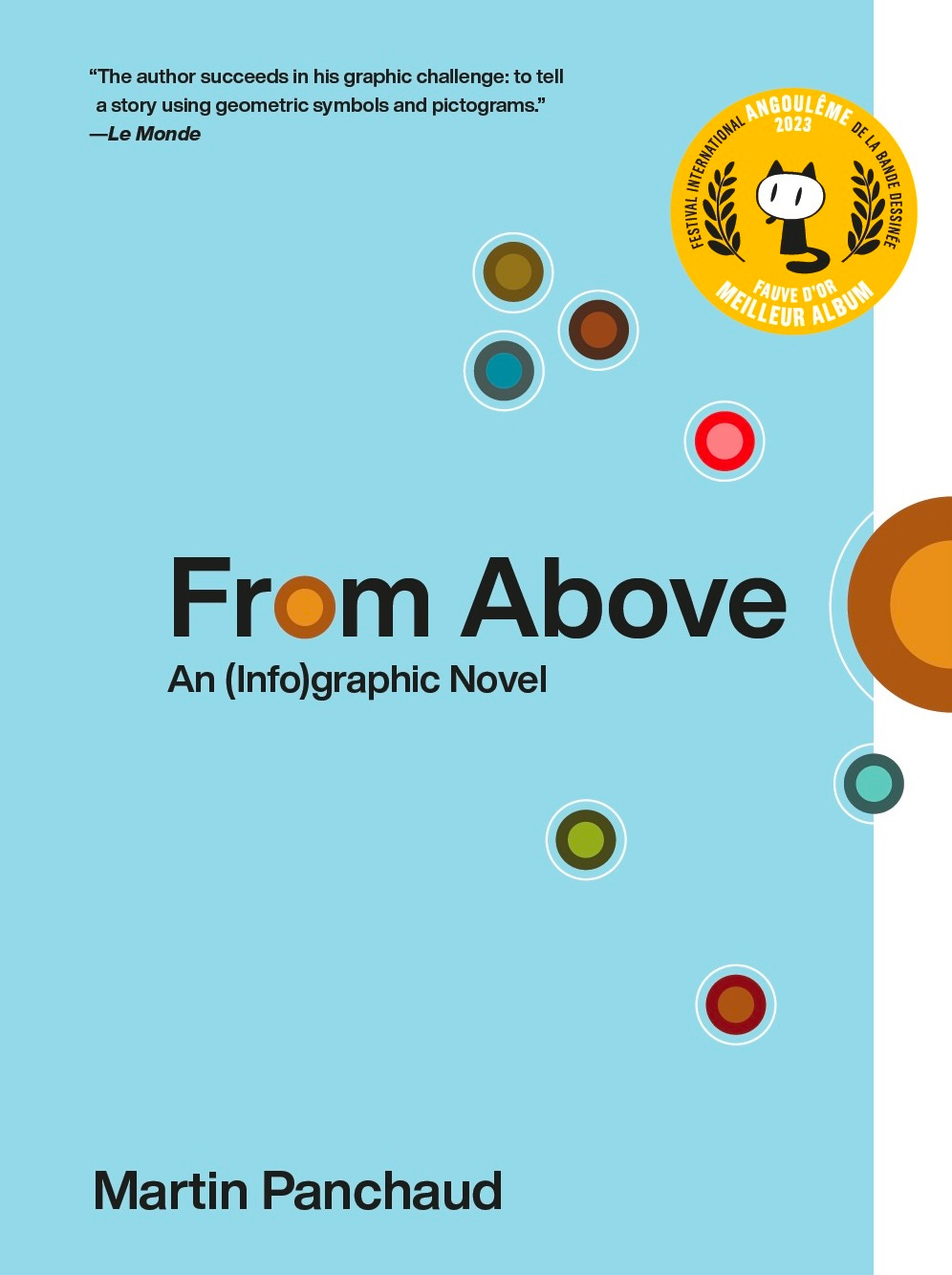
From Above: An (Info)Graphic NovelDyslexic illustrator crafts the most minimalist comicbook ever madeI pitched around a review of Martin Panchaud’s book From Above: An (Info)Graphic Novel. It caused a huge sensation and won several awards when it was published in Europe several years ago, and it was just released in America for the first time on July 22nd by Abrams Books. No outlet took me up on my pitch, so I’m writing about it here. Imagine the entirety of the blockbuster 1977 space opera Star Wars: A New Hope reduced to one long infographic, with all of those iconic characters and settings distilled to the simplest pictograms imaginable. As you scroll downwards, you see red and green laser blasts from space dogfights whiz past…
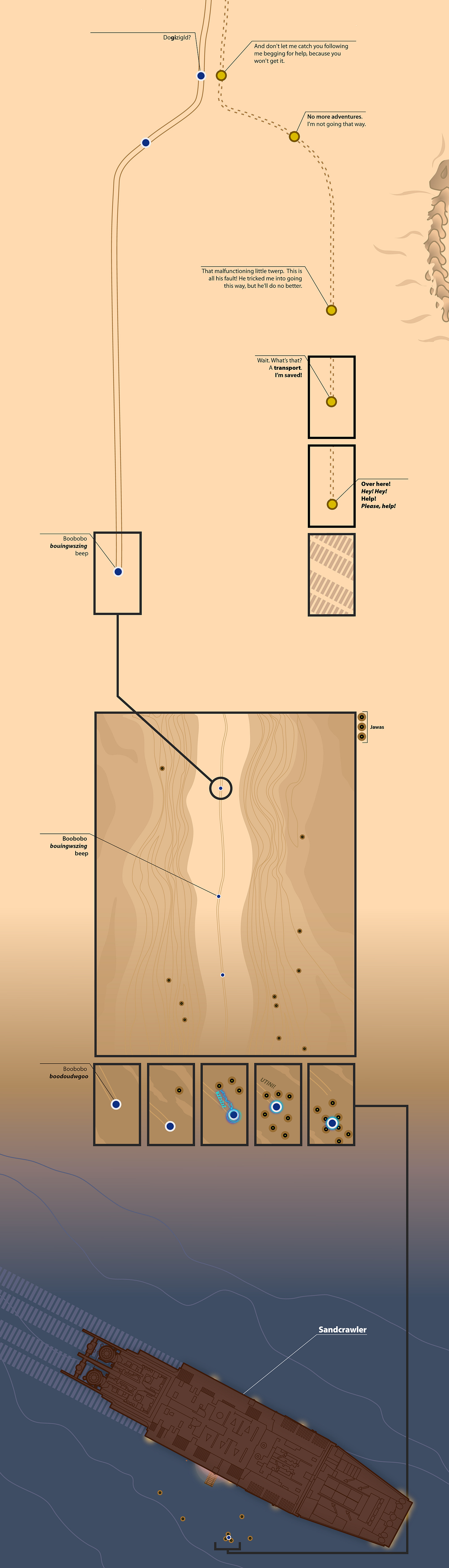
The comic recounts the entire story of the film—every line of dialogue—but it reduces characters to dots, and distills settings to blue prints that chart where those dots are positioned in relation to each other. When the two droids bicker and part ways on the desert planet of Tatooine, you see the paths of their sandy footprints and tire treads diverge…
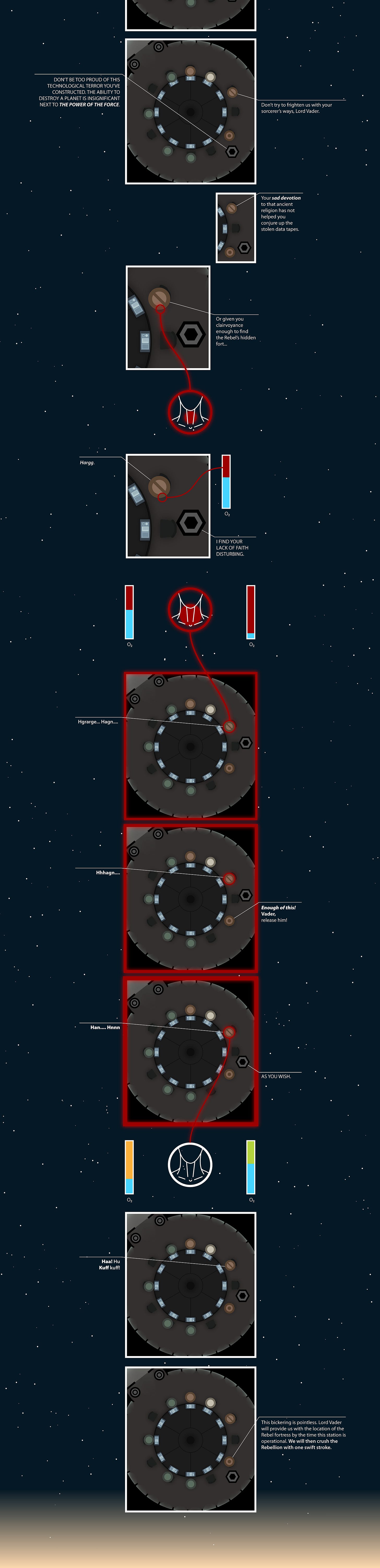
All comics simplify the details of the real world to some extent, and artists like Chris Ware and Randall Munro are known for their minimalist techniques. But there has never been anything quite like this reimagining of Star Wars. When the Darth Vader dot uses the Force to choke one of his underling dots, you see an anatomical cross section of the victim’s neck with an angry red highlight to illustrate the windpipe’s constriction. (An accompanying series of bar graphs track the poor wretch’s declining blood oxygen levels.)
The Swiss artist Martin Panchaud caused a stir when he treated this geek touchstone to such a bold experiment in abstraction. (You can find the full thing at SWANH.net.) The storyline unfolds in one continuous 10-inch wide, 400-foot-tall digital image. Panchaud notes that this would belike scrolling through 3.5 Millennium Falcons in length—if the Millennium Falcon was real. This unusual reimagining of a sci-fi classic created a great deal of buzz when it first appeared in 2016. “This is absolutely STUNNING!” raved Mark Hamill himself. “1st time I've ‘watched’ #StarWars since the '97 #SpecialEdition & well worth it! #GR8Job” But this adaptation leaned on familiar source material to help make its story coherent. Everyone knew the basic beats of the tale, and you keep reading to see how Panchaud would portray memorable setpieces. Like, how would he handle the cantina scene? How could he pull off the tense moment when Han Solo shoots Greedo?
Making a completely original story with unfamiliar characters in this format would be a far greater challenge. But Martin Panchaud has done it. His new graphic novel is the most abstract comic ever made—a new frontier in minimalism. The artist, who was born in Geneva and currently resides in the UK, says he takes inspiration from the storytelling in the Bayeux tapestries and ancient Chinese scrolls, as well as Chris Ware and the Swiss illustrator Warja Lavater. (She retold classic tales like William Tell and Red Riding Hood using only symbols.)
But Panchaud says that the main inspiration for his technique was his profound dyslexia. The condition made it extremely difficult for him to fulfill his grandiose artistic ambitions, and he found himself working the overnight shift in a hotel. He realized that if he ever wanted to accomplish anything creatively, he needed to drastically simplify his vision. “I felt the need to break out of traditional comic methods and find a modern and very minimalistic style to tell my own stories,” he said in an interview.
From Above: An (Info)Graphic Novel tells the eventful story of Simon Hope, a British teen whose life goes seriously awry when a fortune teller provides him with foreknowledge of the outcome of an upcoming horse race. Simon’s got over £16 million pounds sterling coming to him, but there’s no reliable adult in his life that can help him cash in his betting ticket. His mother is in a coma. His father is on the lam. Everyone else is either oblivious to the boy or eager to steal his ticket.
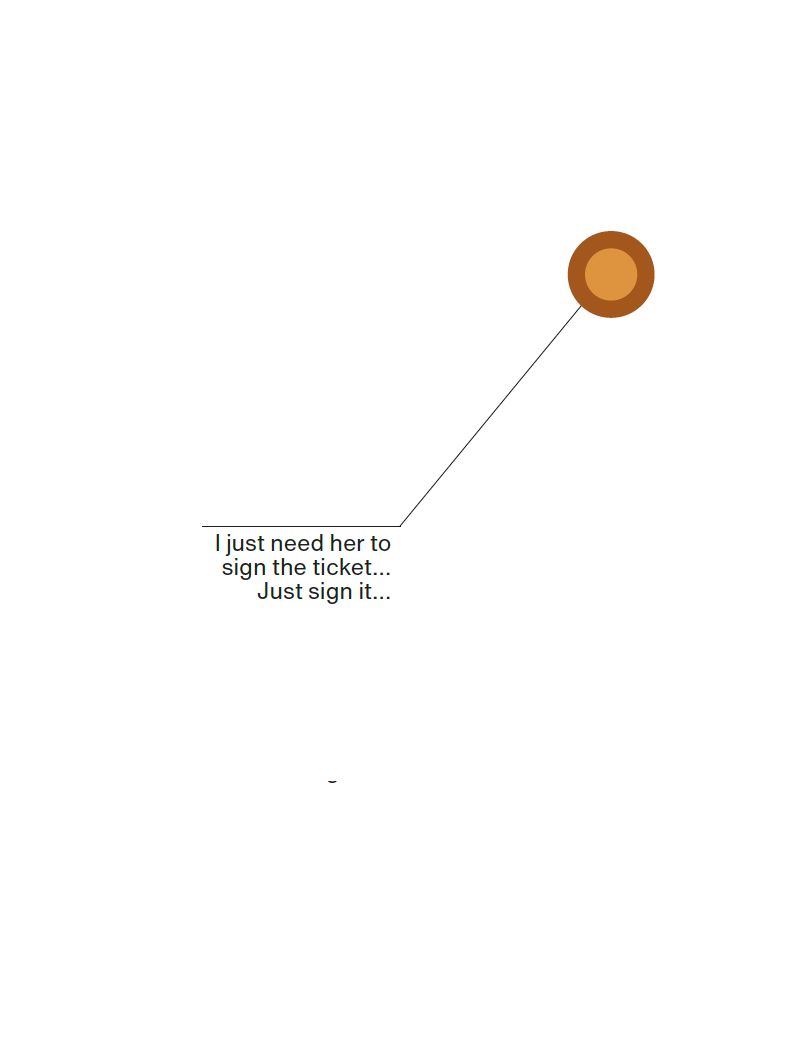
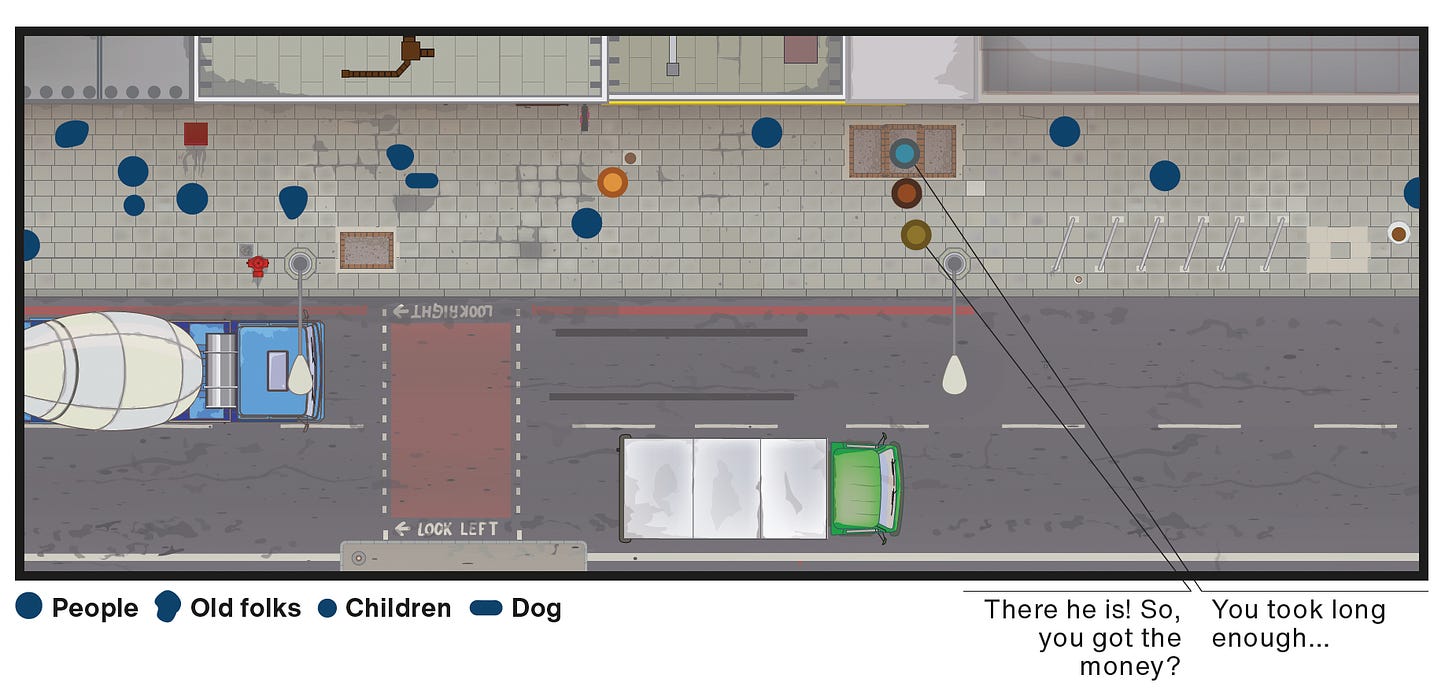
The story that Panchaud tells is alternately tragic, humorous, surreal, and harrowingly suspenseful. It’s remarkably easy to empathize with the graphic novel’s young protagonist despite the fact that he is literally just a brown circle on the page. Simon’s mother is a blue circle, his father is a green circle, and the fortune teller is a purple circle. Crowd scenes often resemble a Twister mat viewed from above. But the story of From Above is consistently comprehensible and compelling.
Whenever additional information is required, Panchaud supplements these bare bones diagrams with charts and map legends and infographics that make Ikea instruction pamphlets look richly detailed in comparison.
Panchaud’s graphic novel is sometimes so abstract that the images function more like computer code than images. And there are some lapses in tone and taste—I’m not sure I needed a detailed diagram of how one of the protagonist’s bullies fashions DIY sex toys out of a thermos and a rubber glove and warm sauerkraut. But the story is always surprisingly easy to follow, and it gets increasingly compelling as you become accustomed to its unique visual language. When a new character is introduced whose circle happens to be the same color as an established character’s circle, we can instantly tell that something is awry. Later, the sight of a small circle within a circle serves as a shocking revelation that one of the characters is pregnant. From Above won widespread critical acclaim when it was published in Europe several years ago, winning awards like the Fauve d'Or and the ABCD Grand Critics’ Prize. The author’s simplistic pictograms have even been optioned for a film adaptation. Panchaud always struggled to read words, but he never had trouble interpreting maps or symbols. So he developed his own unique way of depicting the world. “My visual style leaves more space for the individual imaginary universe,” he said. “The human mind is able to feel empathy for abstract forms if they have been put in a narrative context. ” He views his innovative aesthetic as the ultimate revenge on his dyslexia. |




Genre Exercises
I write speculative fiction, cultural criticism, humor, and journalism, with a particular interest in retrofuturism, video games, fandom, and forgotten corners of pop culture history. My work has been published by Wired, Rolling Stone, Slate, McSweeney’s, Adventitious, The Daily Tomorrow, Alta Journal, Flash Fiction Online, and Nature: Futures. I also publish the newsletter Pop Cultural Precursors.
My story was serialized by The Daily Tomorrow. Their synopsis: "a deathbed codicil, a savage sport, a mechanical replacement, and further complications? Join us for a healthful outing in Chris Baker’s marvellous 'A Duty of Care.' Happy hunting!"Subscribers can read an afterword about the story's making. https://dailytomorrow.substack.com/p/a-duty-of-care-full-story
Everyone should subscribe to this excellent spec-fic quarterly edited by Scott Beggs. Very proud to have a short piece in it.
If you could rewind time and erase your mistakes, would you use that power responisbly? Or would you be undone by undos? Read my piece in Futures: Science Fiction in Nature, and subscribe for more sci-fi flash fiction.I wish more science mags still published speculative fiction. We didn't know how good we had it with Omni back in the day...